← Back to work

Quantum Face Filter

Q.Filter is an experimental interaction prototype exploring how principles from quantum mechanics might inform new ways of representing identity in digital systems.

The project began as a speculative design exploration about digital identity and evolved into a real-time browser prototype that translates the quantum measurement problem into an interactive visual behaviour.

Instead of storing a fixed representation of a person, the system produces temporary states that only emerge during interaction. Identity appears through observation and never fully stabilises.

The prototype asks a simple question: What might systems feel like if identity were contextual, probabilistic and momentary rather than fixed and accumulated?

Speculative Design Quantum Theory Interaction Prototype
Type Speculative design provocation
Origin Global Design Futures, UAL, 2023
Quantum Angle Creative Quantum Computing, IBM x CCI, 2024
Tools MediaPipe FaceMesh, HTML, CSS and JavaScript
Date 2023 — ongoing

The project began with the observation that digital platforms do not passively record identity, they actively produce it.

Every interaction with a digital environment is measured and translated into deterministic systems: profiles, identifiers, categories and scores. Over time, these systems accumulate data and construct increasingly rigid representations of a person.

Human identity, however, is rarely stable or singular. It is contextual, evolving and plural.

How might digital identities respect the fluid nature of self-identity?

The speculative design provocation fl(u)id explored this question through future scenarios about the relationship between identity, technology and control.
Using the hindsight–insight–foresight framework, alongside the PPPP cone and scenario matrix, the research mapped how digital identity systems evolved, how they currently shape behaviour, and how they might influence human identity in the future.

Four scenarios for 2050

Possible

Back to the Future: 1984

Humans are categorised under digital groups, having completely lost their self-identity to the system. Digital platforms form their own identities and govern digital groups through machine consciousness.

Plausible

Nosedive

Digital identity has taken over self-identity. Societies are divided into strata according to digital performance. Those without a good digital score lack basic rights. Those without access to digital worlds are completely marginalised.

Probable

The Multiverse

Humans live in parallel realities. Not only actions but feelings and emotions are tracked. A profound self-identity crisis unfolds, driven by decades of digital manipulation. Human agency is at risk.

Preferable

Stairway to Pluriverse

Human data is recognised as a human right. Technological systems adapt to social and ecological systems. Individuals own their data and can navigate digital spaces with security, privacy, and freedom. Human and non-human agencies coexist.

What ultimately distinguished these futures was who controls the conditions of measurement. In dystopian scenarios, measurement is controlled by platforms and institutions. Identity becomes something imposed and accumulated externally.

In the preferable scenario, individuals control when and how they are observed. Identity becomes contextual, temporary and self-directed.

This insight shaped the design challenge:

What technological architectures might allow identity to remain contextual rather than permanently stored?

Quantum mechanics offers a radically different way of thinking about information. In the quantum world, a system exists in superposition until it interacts with its environment. That interaction forces the wave function to update: the probabilistic description of possible states resolves into a single outcome.

Two properties are particularly interesting for identity systems:

  • Contextuality: the outcome depends on the interaction.
  • Non-persistence: the prior state cannot be perfectly recovered once measured.

This suggested a provocative possibility:

What if identity in digital systems behaved more like a quantum state (contextual, momentary and interaction-dependent) rather than a fixed record stored indefinitely?

Quantum is not only a metaphor for fluidity, but potentially a different architectural logic.

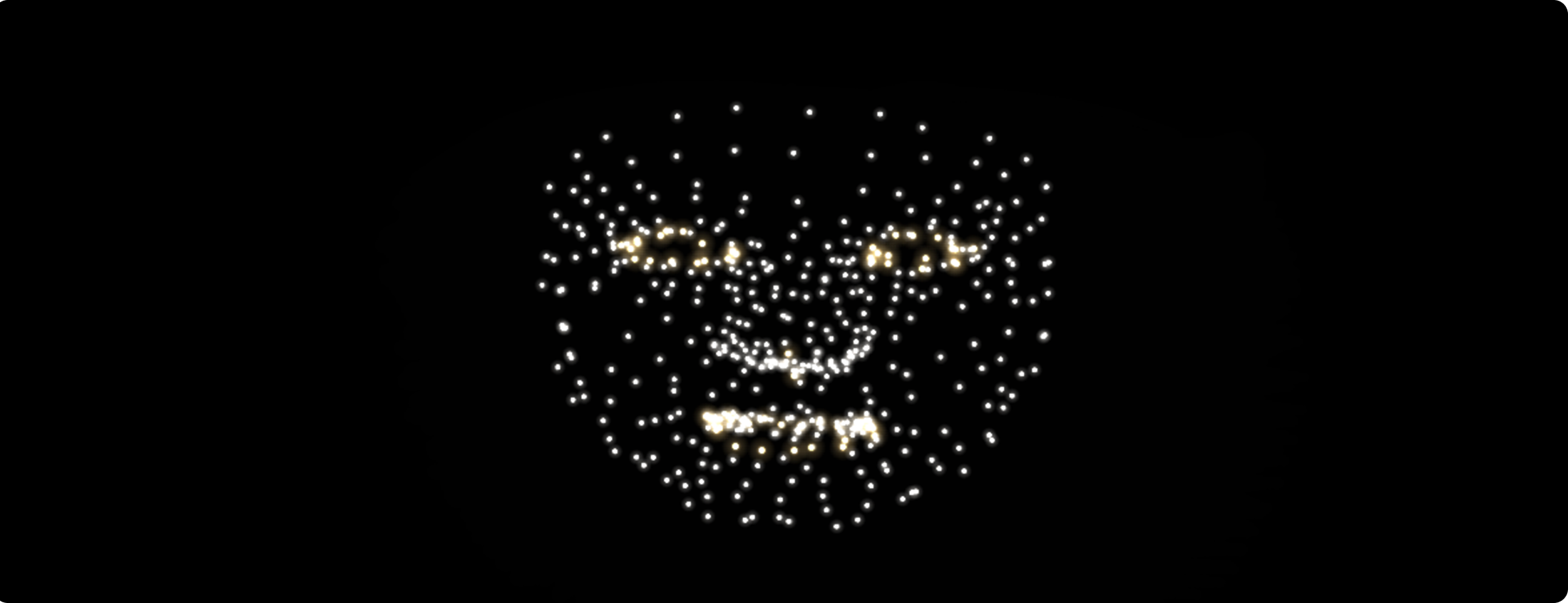
Click to trigger observation collapse · Click again to reset

fl(u)id introduced the question through speculative design. After attending a workshop on creative quantum computing at the Creative Computing Institute, the project evolved toward a more technical exploration.

Quantum computing operates on principles that differ fundamentally from classical computing. In particular, quantum information is difficult to copy or store indefinitely, and measurement fundamentally changes the system.

This suggested a new direction:

Rather than only speculating about identity systems, could a prototype explore what interacting with such a system might feel like?

Q.Filter became an attempt to translate this logic into an interactive experience.

Q.Filter is a live browser-based interaction prototype built with HTML, CSS, JavaScript and MediaPipe FaceMesh. The system tracks 468 facial landmarks in real time using the webcam.

Before a face is detected, particles drift in a diffuse probability cloud. When a face appears, the particles move toward the landmark positions, a behaviour inspired by the collapse of a quantum state during observation.

Even after forming the face, the particles never fully stabilise. Each particle is continuously displaced by an independent sine wave, creating persistent instability similar to quantum noise. The face exists, but never as a fixed representation. Instead, it behaves like a system constantly updating through interaction.

Q.Filter translates three quantum principles into interaction behaviour:

Superposition

Before a face is detected, particles exist as a diffuse probability cloud rather than a defined structure.

Observation / collapse

When the system detects a face, particles move toward the 468 facial landmarks. The act of observation produces the visible form.

Residual uncertainty

Even after collapse, particles continue drifting through independent oscillations. The system never stabilises into a perfectly fixed state.

Rather than representing identity as a static object, the interface presents it as a behaviour that emerges through interaction.

System behaviour

Camera Input
Face Detection (MediaPipe)
Landmarks (468 pts)
Particle System

State Behaviour

· Superposition

· Collapse on detection

· Continuous noise

MediaPipe FaceMesh

Google's real-time facial landmark detection (468 points) running directly in the browser.

Canvas API

Each frame is drawn manually. Additive blending, semi-transparent fade, and per-particle sine displacement are all handled in raw canvas 2D.

Quantum noise simulation

Each particle has an independent sine-wave displacement with a random phase, ensuring the system never synchronises into a stable state.

Linear interpolation

Particles gradually chase their target landmarks, creating a smooth "collapse" behaviour rather than a discrete jump.

Ultimately, Q.Filter is not intended as a finished product but as a research probe. It explores how quantum principles might translate into an interface behaviour people can experience directly, and whether such systems could return greater agency to the people they represent.

If identity were generated through contextual interactions rather than stored profiles:

  • Systems would accumulate less permanent personal data
  • Identity could remain plural and context-dependent
  • Users could have more control over when and how they are observed

Current explorations include experiments in TouchDesigner to expand the visual behaviour and real-time responsiveness of the system. Future work aims to integrate quantum-generated randomness, replacing simulated noise with genuine quantum outputs.

Next project Sound Has Context

I would love to chat with you!

Send me an email at clara.astiochoa@gmail.com
or find me on LinkedIn