Samsung UK asked: where is European lifestyle heading, and what role should Samsung Appliances play in it? The brief was deliberately open, an invitation to look at where society is going and work backwards to what the technology could become.
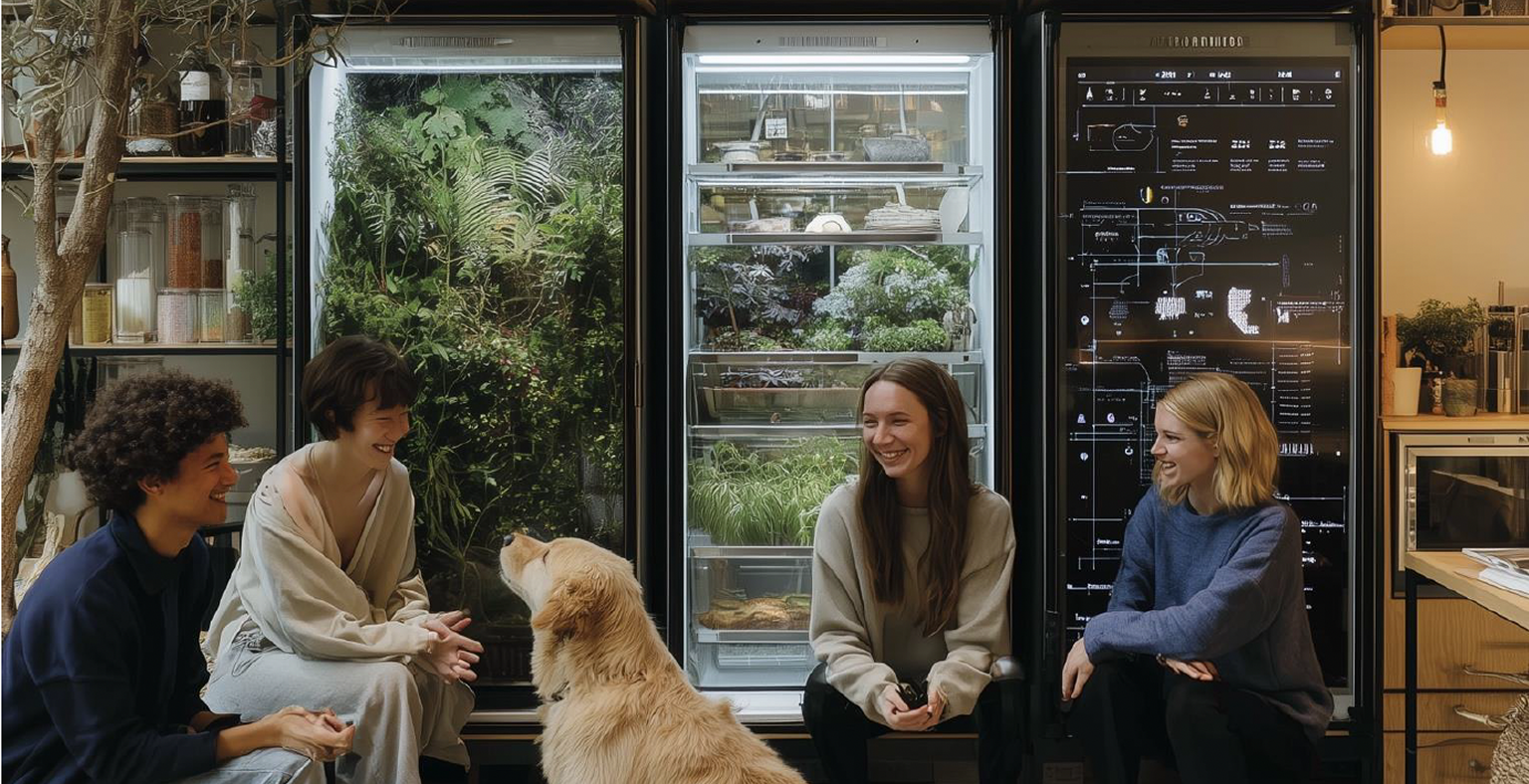
A futures research and speculative design brief for Samsung, presented at Samsung HQ London. Starting from Europe's housing crisis, the project forecasts how communal living might reshape the home and proposes what Samsung Appliances could become inside it.
Samsung UK asked: where is European lifestyle heading, and what role should Samsung Appliances play in it? The brief was deliberately open, an invitation to look at where society is going and work backwards to what the technology could become.
The starting point was structural: Europe is undergoing a generational shift in how people live. Economic precarity, demographic change, and the pandemic of loneliness are converging to make shared and communal living an economic necessity for a significant portion of the population.
Europe accounted for 47.5% of the global co-living market, with early adopters redefining what independence and ownership looked like:
These signals pointed to a clear direction: the household as Samsung has always designed for might no longer be the dominant unit of European domestic life.
What happens to the designed object when the household is no longer a unit of private ownership?
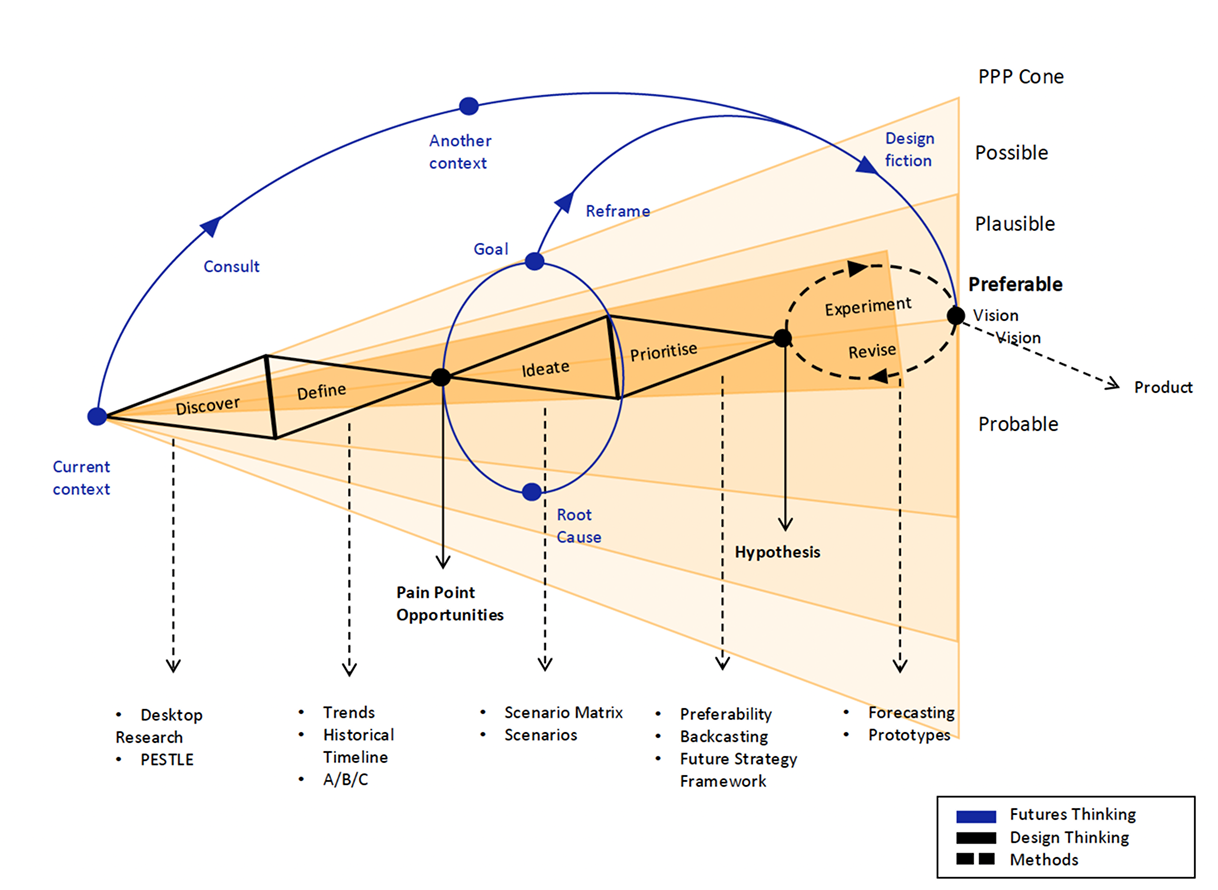
To structure the work, I adapted an existing futures research framework combining the PPP Cone (Possible, Plausible, Probable, Preferable) with the Double Diamond design process. The goal was to embed Samsung's core values (People, Change, Co-Prosperity) directly into the methodology.
The four phases of the work were:
By grounding futures work in this structure, diverging to explore what was possible before converging on what was preferable, the methodology kept the speculative outputs tethered to concrete product and business logic.
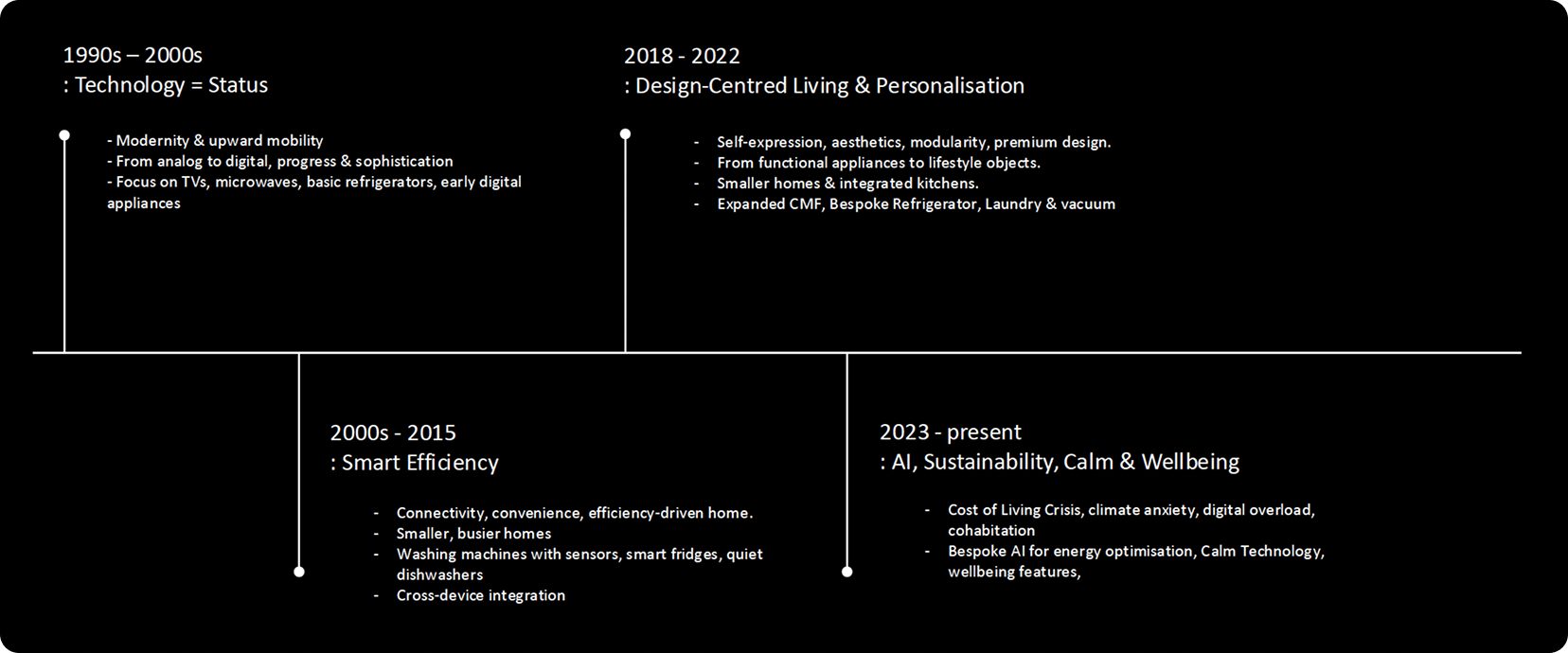
Samsung had evolved in step with European consumers at every major inflection point. From Technology as Status in the 1990s, through Smart Efficiency and Design-Centred Living, to the current era of AI, Calm, and Wellbeing.
The competitive analysis, however, revealed a gap. The market's vocabulary (LG's multi-unit stacks, Bosch's connected efficiency, Miele's longevity positioning) was still organised around the individual or the traditional family.
Samsung was uniquely positioned to occupy a new space, but only if it moved before the co-living generation formed its brand loyalties elsewhere.
The scenario work mapped four possible trajectories for European domestic life, ranging from hyper-individualism driven by techno-determinism to post-anthropogenic ecologies where technology serves non-human actors. The preferred scenario that emerged was Symbiotic Home Ecologies.
Future scenarios matrix · 2024
In this future, the home is not a private island but an ecological node. Humans are not at the centre, but they are part of a mesh of equal agencies: ecosystems, objects, materials, microbes, infrastructures, and neighbourhoods. Technologies become civic-material actors shaping care, stewardship, and ecological continuity.
Appliances operate on planetary timescales:
This scenario was preferred because it was the most generative for Samsung. It forced the hardest design questions about identity, shared agency, and ecological responsibility, and the answers translated directly into meaningful product innovation.
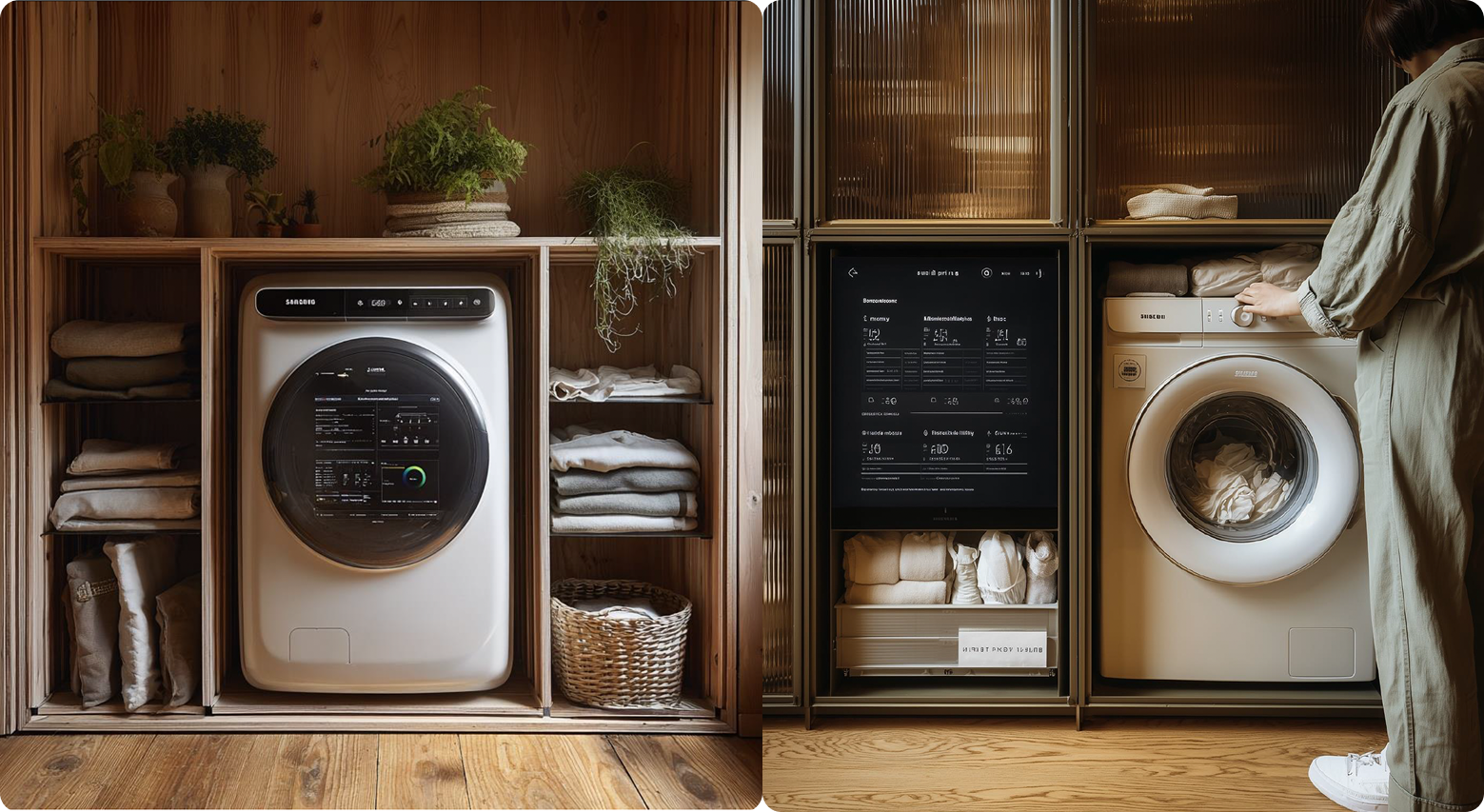
Working backwards from the Symbiotic Home Ecologies scenario, I developed three speculative design concepts under a single product family: Samsung Share Cycle, the world's first laundry system designed for shared European homes. The concepts spanned software, hardware, and financial infrastructure.
Across the three concepts, the work proposed systems that allowed co-residents to manage laundry independently within a shared appliance, addressed dignity and privacy for households with differing cultural or hygiene needs, and introduced transparent cost and energy tracking at the individual level. Together, the concepts reframed the appliance not as a household utility but as a fairness infrastructure: a system that reduces friction, supports autonomy, and makes the social dynamics of shared living visible and negotiable.
The dominant paradigm in product design remains humanist. Drawing on critical post-humanist frameworks - which extend ethical consideration beyond the human to encompass non-human actors, shared material conditions, and ecological entanglement - this project asked what design practice looks like when the household is understood not as a unit of individual ownership but as a node in a larger mesh of interdependencies.
The shift is not merely philosophical. As machine consciousness might become a design variable and planetary health a material constraint, the assumptions embedded in current industry standards become liabilities.
What this project attempted was a translation from theoretical frameworks that have largely remained within academic discourse, into a form legible to product strategy and innovation roadmaps.
Send me an email at
or find me on LinkedIn